Editorial | The 10th Anniversary
European leaders start to realise that digital, cognitive dependency is a vulnerability. Truth is, we've been in this situation since 2016, to say the least.

It looks like Europe, or at least a part of it, is finally realising that its dependence on foreign digital infrastructure constitutes a great vulnerability. I do not mean the real possibility of having essential services, like banking, shut down by presidential request from one day to the next. Instead, I mean the digital ecosystem that grounds our cognitive infrastructure, which shapes how we access and understand the world beyond our immediate - and gradually irrelevant - grasp. Of course, social media is at its very core, and it has been shaping public discourse and imagery for a long time now.
It is well-known that hardcore anti-European parties like AfD thrive because of the immense support that they receive from X's owner, Elon Musk. We all know what is powering this whole ecosystem of YouTube alt-right influencers - hint, algorithmic manipulation and, well, funding. It is obvious that without shows Joe Rogan's podcast, a second Trump term would have been way more difficult to achieve.
The data is out there, and I encourage you not believe any of these words, but to contrast all these claims by yourselves. You'd be surprised on how easy that can actually be.
Then there is the more anecdotal, but still significant, personal experience you might have. Just open the curated feed you might have in the platform of your choosing. Look at the recommendations, slowly, and ask yourself why you're seeing what you're seeing. Ask yourself: has it always looked like this? Didn’t it change at some point (maybe around the Pandemic)? Again, this is just personal recalling, not rigorous journalistic practice (although I never claimed to be a journalist).
So, if you allow me, let me share a specific example with you: I like to listen to a wide range of music, and as it happens, that includes beautiful, medieval Gregorian chants. For some reason, when I listen to them on YouTube, the platform would recommend me videos from all sorts of right-wing influencers, presumably because YouTube assumes that the general public of this music is "trad". However, it is intriguing, to say the least, how Testamentum aeternum and Tucker Carlson's channel might be related (I reran the experiment before publishing this article, just for you). And this is not an isolated situation. How come I am aware of a bunch of right-wing channels on YouTube, while I would struggle to name more than a couple of left-leaning channels? Of course, "Left" and "Right" are taken here as they are understood in the general context of the US, not how I believe those terms ought to be used.
Now, individual experiences aside, the EU seems to be (slowly) realising that this is actually a pretty big social problem. Indeed, to have hostile actors meddling in your internal, sovereign affairs is not an optimal situation. In this line, the Commission has mobilised the Digital Services Act (DSA). For instance, it has declared WhatsApp as a big platform, and therefore more accountable for the content it distributes. You can see this as a result of WhatsApp following the steps of other platforms like Telegram, in the sense that both operate not only as a messaging service, but also act, more and more, like social media platforms. By the way, Telegram deliberately underreports the number of users it has in the EU to avoid being similarly scrutinised under the DSA.
More actions have come out from the EU. X is under scrutiny for algorithmic manipulation, and for literally distributing AI-generated child pornography, and non-consensual AI-generated pornography in general. Yes, the alleged "world's agora" (it is not) has an integrated chatbot that claims to be MechaHitler and generates porn.
There has been action from national governments, too. X's headquarters in France were recently searched by the police, among concerns of algorithmic manipulation and, again, CSAM distribution, to name a few things. Moreover, during the last World Governments Summit in Dubai, Pedro Sánchez, Spain's prime minister, announced its intention to regulate further social-media platforms, including a proposed ban for people under sixteen. And Elon Musk responded to Sánchez's declarations, calling him a tyrant. Similarly, many Telegram users in Spain received the following message, pretty much in the same style as government-issued meteorological alerts. The original message is actually from Telegram's founder, Pavel Durov, which was forwarded through the official Telegram channel:
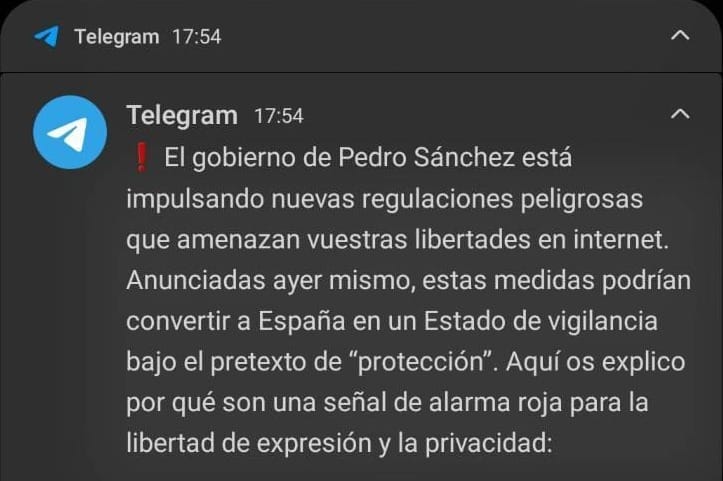
There are genuine concerns related to age verification, one of the issues mentioned in the message, and I will cover that in another article. That said, images like this explain why more and more governments in Europe seem to be worried by the leverage that Big Tech platforms (a misleading name, since their main source of revenue is ads, not groundbreaking technological innovation) hold. Interestingly, there has always been a consensus in the West regarding the fact that many Chinese platforms are not fully trustworthy, not because of their technical unreliability, but because those platforms are usually seen as an extension of the Chinese state. To put it simply, I doubt we will ever see the President of the European Commission and the President of the Council of the European Union talking over WeChat. But - and here’s what everyone needs to understand - American platforms are not separable from the US Government either. The same logic applies both ways. And the same goes for other platforms, which unsurprisingly only serve the interests of those who own them.
The Epstein files make even more evident the claims with which I began this article. We know that Jeffrey Epstein met 4chan founder Christopher Poole, and that both held correspondence afterwards. 4chan always considered Trump’s 2016 victory a victory of its own, and, be as it may, the coordinated propaganda efforts they dubbed the “Great Meme War” did play a major role in shaping public opinion at the time. We also have records of Epstein and Palantir's CEO Peter Thiel celebrating Brexit and the "return to tribalism". This was also in 2016. Both events - Brexit and Trump's election - were facilitated by plots like the Facebook-Cambridge Analytica. I will not mention the presence of Trump and company in those files because we already know that for a long time.
Again, our politicians seem to, at least in part, be discovering that this situation of digital vassalage and interference is untenable; that all of this goes against basic principles of sovereignty and accountability, because those who control the critical infrastructures of the state, control the state itself. And the cognitive, digital infrastructure is no exception in a mass society like ours.
But elected officials are not the only ones realising this. More and more people seem to be finally acknowledging that information and communication technologies are no longer something that should matter only to a bunch of enthusiasts, nor that they are only an "optional" aspect of our individual and collective existence.
Many of these problems are as old as the Industrial Revolution itself. But if we had to be more specific and point to the moment in history in which all of this (algorithmic, discretionary manipulation, the poles of truth and falsity diluted into a total bullshit-entropy) became unavoidably explicit, it would not be 2020, or 2025. That would be 2016. The year of Brexit. The year of Trump's first election. Funnily enough, the year in which the Oxford Dictionaries word for 2016 was post-truth. It would be beautiful if, ten years later, 2026 becomes the year in which we finally move forward, and reclaim control over our politics - and minds. Let's work for it, together.


